Showing posts with label Ethiopia. Show all posts

Saturday, April 19, 2008

America supporting a failed state in Africa

Olympics in Addis Ababa for 2016! Ethiopia in lockstep with China in suppressing all who oppose "their will."

By Ernest Mpinganjira

A political disaster is looming in Ethiopia. The Government cracked down on opposition supporters in a desperate attempt to prevent Prime Minister Meles Zenawi’s rivals from entrenching themselves at the grassroots.

One of the parties boycotted village, district and provincial elections. Another party threatened to follow suit in protest about uneven playing field and repression against opposition.

Against the backdrop of blatant human rights abuses, international organisations have raised concerns about the West’s silence over its ally’s excesses.

A Human Rights Watch (HRW) report last week accuses Addis Ababa of harassment of the opposition and independent Press. The report also questioned whether the US military aid to Addis Ababa has been used to suppress the opposition and entrench Zenawi into power.

The report noted: "The Ethiopian Government’s repression of registered opposition parties and ordinary voters has largely prevented political competition ahead of local elections that began on April 13.

"These widespread acts of violence, arbitrary detention and intimidation mirror long-term patterns of abuse designed to suppress political dissent in Ethiopia."

HRW Africa Director, Mr Georgette Gagnon, expressed dismay that while the ills persisted, the US has not raised concern over curtailment of democracy and independent media.

HRW said the repression was a preamble to national elections slated for November.

"It is too late to salvage these [grassroots] elections, which will simply be a rubber stamp on the EPRDF’s (Ethiopian People’s Revolutionary Democratic Front, Ethiopia ruling party) near-monopoly on power at the local level. Still, officials must at least allow the voters to decide how and whether to cast their ballots without intimidation," Gagnon said.

Ethiopia’s election chaos comes hot on the heels of the debacle in Kenya that resulted in 1,200 deaths and more than 350,000 people displaced. In 2005, Ethiopian forces killed 200 opposition supporters and detained dozens of others for protesting Zenawi’s poll win.

The US’s silence about Zenawi’s political mischief has elicited international concerns. The Economist magazine questioned the silence, which could encourage some African governments to ignore the rule of law and suppress democracy.

The magazine provided a glimpse of what thinking in Washington could be: The close military ties between the two countries that involve the civil strife in Somalia.

The US, it said, fears that Somalia may have already become an incubator of international terrorism, hence its reluctance to criticise Zenawi, lest he welcomes the terrorists in reaction to criticism.

"That is why America backed Ethiopia’s invasion of Somalia at the end of 2006. Its own air raids on supposed terrorist targets in Somalia have relied on Ethiopian intelligence, though nearly all appear to have missed.

"American officials praise the Ethiopian troops who are still in Mogadishu, Somalia’s battered capital, as peacekeepers; most Somalis see them as occupier," writes the magazine.

Civil strife

Kenya’s political chaos after the disputed December 27 polls seem to have shielded Addis Ababa from international criticism on gross abuse of human rights.

Until last December’s disputed presidential poll in Kenya, Nairobi was the presumptive anchor of US interests in the larger East African region. Recent political turmoil have weakened this position, hence the Bush administration’s partiality to the savagery in Ethiopia.

"...The Pentagon wants to make Ethiopia a bulwark in a region where Somalia is a dangerously failed state, Sudan and Eritrea are pariahs and Kenya has troubles of its own," The Economist noted.

Some of the reasons the magazine gives for Ethiopia’s persistence in abrogation of human rights, which are largely true, are appalling.

"The African Union is based there. Its ancient Christian history stirs American evangelicals. Its poverty and population of 80 million, (Africa’s third-largest) attract development-minded foreigners," The Economist says.

But as the international community busied itself with the developments in Zimbabwe, where presidential poll results are yet to be released, Addis Ababa was clamping down on opposition during grassroots elections.

Said HRW report: "The nationwide local elections…are crucially important. It is local officials who are responsible for much of the day-to-day repression that characterises governance in Ethiopia. Many local officials in Oromia have made a routine practice of justifying their abuses by accusing law-abiding government critics of belonging to the outlawed Oromo Liberation Front."

The report said that as a result of the intimidation, candidates allied to the EPRDF are elected unopposed in the vast majority of constituencies across Ethiopia.

This was after opposition coalition, the United Ethiopian Democratic Forces (UEDF), withdrew its candidates for fear of persecution.

"UEDF officials complained that intimidation and procedural irregularities limited registration to only 6,000 of the 20,000 candidates they attempted to put forward for various seats," the HRW report says.

Just as was the case in Kenya, Zimbabwe and Nigeria in 2006, Ethiopia’s National Elections Board (NEB) came under stinging criticism for bending the rules in favour of the governing party.

Against this pattern of abuse, HRW London Director, Mr Tom Porteous, took issue with the West for backing a brutal regime.

"If Western governments were more consistent and less selective in their reaction to human rights abuses around the world, they might be less inclined to turn a blind eye to Ethiopia’s failure to abide by international norms …" Porteous observed last week.

source: http://www.eastandard.net/columnists/?id=1143985093&cid=190


Wednesday, July 18, 2007

US exasperated by Ethiopian backsliding on democracy


July 18, 2007 (WASHINGTON) — Both the Bush administration and Congress are growing exasperated over Ethiopia’s backsliding from democracy but are wary of applying too much pressure against a country that has become an important anti-terror ally in East Africa.


Members of the Democratic-controlled Congress are under fewer restraints than President George W. Bush’s administration, which has relied on the help of Ethiopian troops in ousting Islamic militants from power in parts of neighboring Somalia.

In the House of Representatives, the Africa subcommittee of the Foreign Affairs Committee is completing work Wednesday on legislation that decries Ethiopia’s recent human rights record and opens the door for sanctions. The subcommittee’s approval would be a first major step, but the bill still would have to be passed by both houses of Congress and signed into law by Bush.

Democratic Rep. Donald Payne, the subcommittee’s chairman, told The Associated Press he has had no response to his bill from White House officials, but "I think they would prefer if we just left it alone."

"This is not a punitive bill," he said. Any sanctions would kick in only if Ethiopian Prime Minister Meles Zenawi’s government does not return to democracy and restore human rights protections.

On Monday, a court in the Ethiopian capital Addis Ababa sentenced 35 opposition politicians and activists to life in prison and eight others to lesser terms for inciting violence in an attempt to overthrow the government. Judges threw out charges of treason and attempted genocide and rejected the government’s recommendation for death sentences.

The Federal High Court trial began in December 2005 after the opposition organized protests following elections earlier that year that foreign observers said were badly flawed. The demonstrations were smashed by police, and scores were killed.

The defendants asked for pardons in a letter sent to Meles weeks before the sentences were announced. In testimony before the Senate Foreign Relations Committee on Tuesday, Barry F. Lowenkron, assistant secretary of state for democracy and human rights, said Meles announced Monday that he would recommend clemency. The announcement apparently was not made publicly.

The Bush administration has made spreading democracy a cornerstone of its foreign policy. But the administration has had to violate the principle more than once: refusing to deal with objectionable elected governments, such as that headed by the militant Islamic group Hamas in the Palestinian territories. It also has dealt with clearly undemocratic governments such as those in some former Soviet republics in Central Asia.

In an indication that even the administration has determined not to pull all its punches in Ethiopia, Lowenkron’s testimony before the Senate Foreign Affairs Committee was relatively straightforward and at times harsh.

He spoke of the illegal detention of "opposition leaders and tens of thousands of their supporters" and said: "To this day the crackdown casts a shadow over the Ethiopian government."

Lowenkron said he had spent 85 minutes of a 90-minute conversation with Meles in March discussing the state of democracy in Ethiopia and Meles said he would make changes "because it’s in the interest of the people of Ethiopia."

"I told him it should be in the interest of all the people of Ethiopia, including those that are in prison and need to be let out," Lowenkron said.

Democratic Sen. Russell Feingold, who chaired the hearing, urged strong action to right the Ethiopian situation.

"We cannot tolerate a country like that moving in the wrong direction if they want to have the relationship with us that they want to have and that we want to have with them," Feingold said.

(AP)


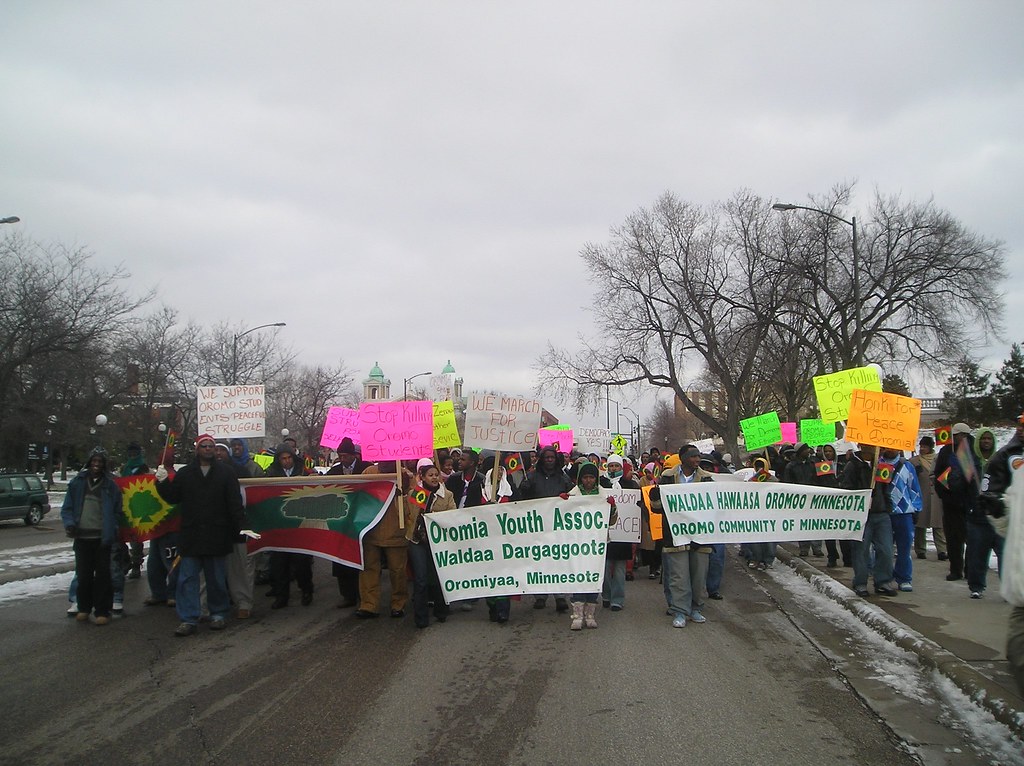
( The above is a photo of Oromo living in Minnesota marching for justice and peace for their people in Ethiopia. The US Government continues to support Ethiopia, who occupy Oromo and Somali lands. The American theory is that the "enemy of our enemy is our friend." This theory didn't work well with Iraq, who was our ally against Iran, as they murdered Kurds. )

Tuesday, July 17, 2007

Ethiopia needs to take seriously democracy and human rights

Editorial, The Wall Street Journal

July 17, 2007 — Let’s play name-that-state. After the EU declared its 2005 elections flawed, this country’s troops killed 193 protestors and arrested 20,000 more. Last week, 42 of the accused were convicted of inciting violence to overthrow the state (down from an original charge of genocide and treason). Thirty-five were condemned to life in prison and forbidden to vote on Monday. Some of the accused were journalists, so their publishing houses were fined and closed.

Did you guess Ethiopia? Probably not, since this African state has often been held up as a pillar of good governance on a troubled continent. In just over a decade, Ethiopia went from military rule to a parliamentary system. But this democracy is on paper only.

The convictions are not an isolated incident, nor are the 42 defendants just any opposition figures. They include the elected mayor of Ethiopia’s capital, Addis Ababa, a former Harvard scholar and a former U.N. envoy. They’ve been condemned to the same fate, life in prison, as ousted military strongman Mengistu Hailee Mariam, who is held responsible for the murder of 150,000 academics and university students in two decades in power.

Given the government’s recent record, it’s odd to say the least to see Prime Minister Meles Zenawi advise Tony Blair’s Commission for Africa in 2005 on the future of the continent. Or to hear that the Bush Administration considers Mr. Meles a "staunch ally" in the war on terror for searching out al Qaeda suspects during Ethiopia’s messy military intervention in neighboring Somalia and makes the country a priority recipient of U.S. assistance. (The world last year sent $1.6 billion.)

America needs to work with all kinds of regimes and military cooperation doesn’t always have to be tied to democratic progress. But if Ethiopia wants to become a real ally of the U.S., possibly playing host to the new African Command, it needs to take seriously democracy and human rights.

Monday, July 16, 2007

Ethiopia slaps life sentences on more than 30 opposition figures

KALITI, Ethiopia (AFP) - Ethiopia's high court on Monday sentenced 35 opposition leaders to life imprisonment for inciting rebellion, after the prosecution had asked for the death penalty. if
Those sentenced in the wake of violence that rocked the capital during 2005 elections included Hailu Shawl and Bernahu Nega, two senior leaders of the opposition Coalition for Unity and Democracy (CUD) party.

Five of the life sentences handed down by the court sitting in Kaliti, some 25 kilometres (16 miles) from the capital Addis Ababa, were given in absentia.

Eight of the 38 defendants present received prison terms ranging from 18 months to 18 years from judge Adil Ahmed.

"Even though some of the accused have been found guilty of multiple charges the court has deemed life imprisonment as a sufficient and comprehensive verdict for the action taken," Adil said.

All the defendants can appeal the ruling in the Supreme Court and as a last resort ask for presidential pardon.

The London-based rights watchdog Amnesty International protested the sentences and called for the defendants' release.

"On the basis of the information we have, most -- if not all -- of those sentenced today are prisoners of conscience imprisoned on account of their opinions, who have not used or advocated violence and should therefore be immediately and unconditionally released," Erwin van der Borght, Director of Amnesty's Africa Programme, said in a statement.

Prosecutors last week had requested the death penalty for 38 of the defendants, who were among scores put on trial on charges of inciting the violence following the disputed polls which the ruling party won but the opposition claims were rigged.

"According to the country's penal code maximum punishment should be dealt to parties found guilty of plotting against the constitution," chief prosecutor Abraha Tetemke had said on July 9.

News that prosecutors had requested the death penalty earned the US-backed regime of Prime Minister Meles Zenawi a warning from Washington.

"We call on the Ethiopian government and High Court to take action in making a final sentencing determination which is consistent with the greater objectives of bolstering the rule of law and promoting much-needed reconciliation," State Department spokesman Sean McCormack had said.

The Paris-based media watchdog Reporters Without Borders (RSF) had also expressed great concern last week and described the prosecutors' requested sentence as "outrageous"

"By demanding the death penalty for members of the Coalition for Unity and Democracy, the prosecutor has confirmed to the international community that Prime Minister Meles Zenawi's government is trying to stifle all political opposition," RSF said in a statement last week.

Four journalists were among the defendants. One was sentenced to life in prison, while the other three received sentences of 18 years, three years and 18 months respectively.

The verdict "didn't come as a surprise, we all expected it," said a relative of one of the main defendants speaking on condition of anonymity. "There is absolutely nothing to regret in their actions".

Earlier this year, the Ethiopian parliament approved a report which said 193 civilians and six policemen died during the unrest in 2005 in one of the darkest chapters in the country's recent past.

The violence in Addis Ababa and other cities in June and November 2005 "occurred due to infancy of the democratic system of the country", the report said.

The figures compiled by the inquiry were three times higher than the government's official death toll of 54, prompting protests from Western donors.

Tuesday, December 26, 2006

Merry Christmas in Kaliti Jail-Ethiopia

Merry Christmas in Kaliti Jail-Ethiopia
December 23, 2006 12:00 PM EST

Having the nerve to spend a few festive days, exchanging gifts and sharing moments of gullible if not guilty happiness is an outrage, when on this very planet, dozens of millions in a single country are stripped of their national homeland, hundreds of thousands are tyrannized under the boot of a shameful, totalitarian regime, and dozens of thousands are tortured in jails because of their political aspirations for Democracy and their national expectations for a Free Oromo Ethiopia.

End the Hell of Hells Abyssinia, the country that usurped the fair name of Ethiopia!

The world should listen to both parts, the oppressors and the oppressed, to get a final idea, before action is taken. This article, first of a series of authentic papers and texts written by both sides, brings to your wonderfully decorated house the testimony of a tortured young Oromo scholar, who after spending two years in the Gulag of Abyssinia, found peace in Djibouti as refugee. Throughout the text Finfinne, the real capital name of Ethiopia, stands for ‘Addis Ababa’. And never forget; as long as Amharas and Tigrays tyrannize the Christian, Muslim and Animist Oromos, Sidamas, Ogadenis, and Afars, the country should not be called ‘Ethiopia’, but Abyssinia.

Listen to the voice of Mr. Madda Walabu, Oromo Biologist, and try to find out what went wrong with our Humanity. Read his own text, and evaluate for yourselves to what extent you believe in a God of Love and Justice, either you are Christian, Muslim, Jewish or believer of any other religion.

All ye that pass by, behold, and see if there be any sorrow like unto his sorrow.

My memories from the Kaliti Jail

By Walabu Madda – Oromo biologist, former Kaliti jail detainee, currently refugee in Djibouti

The Kaliti Jail resembles more to a concentration camp than to regular African prison. It is located in the south-eastern outskirts of Finfinne. Kaliti jail is actually one of the two most notorious prisons of conscience in Abyssinia. The other one is known as the Central Federal Jail.

Prisoners are usually transferred from other jails throughout Abyssinia to Kaliti jail as this jail is the ‘correct’ place for more intense torture and severe, inhuman punishment. The buildings are made of grey stone. Numerous rooms have been arranged for accommodating thousands of prisoners.

Welcome to a Kaliti jail room!

The room I was in was approximately 16x16m, and although it sounds improbable in its 256m2 were accommodated around 100 prisoners, literally squeezed as in a sardine conserve. The only space everyone gets is the space needed for one’s body. If at a moment you happen to turn around, you automatically touch the person next to you - or under you - or above you!

All prisoners sleep on concrete floor, and they are given small, thin mats. While sleeping or at the moment of awaking, the person who sleeps on the edge of your head extends his feet, subsequently hitting you as you are equally positioned to do the same to others. The hit is not deliberate but due to dramatic lack of space.

Abominable hygiene conditions

Perhaps worse than the torture, the low hygiene. Kaliti is worse than what I had imagined as hell, when I was a child. When the room is congested with hundreds of prisoners, it is so unbearably filthy that every minute looks as long as a century of misery. Under these circumstances, it is only normal that, if one has got flu, the next day everyone in the room has flu too. This is however the least, as prisoners are constantly exposed to a great number of contagious diseases, grave contaminations, and lethal sicknesses.

Amhara – Tigray anti-Oromo racism best expressed in Health

Sick Oromo prisoners are never taken to clinics. Actually, no one cares about a prisoner's health. When a prisoner is stricken by a disease, this is rather viewed by the inhuman jail authorities as a most welcome form of torture, something to be added to the conventional torture that is constantly perpetrated by prison officials.

No toiletry for Oromos!

The time prisoners are allowed to spend in the toilet is restricted to a few minutes twice a day, in the morning and the evening. The time in-between prisoners are constrained to stay in their congested rooms; horribly enough, some prisoners who have runny stomach can't wait until the time officially fixed for toilet visit. They are therefore inhumanly forced to discharge their excrements in the very limited space reserved for themselves, next to so many others, making therefore the whole room stink unbearably and appallingly.

All sorts of insects, rats, etc.

As second type of severe hygiene problem is caused by a great number of most disturbing and extremely perilous parasites that also dwell in the congested prisoner rooms. These rooms are the abode of lice, fleas, and their likes. At times, rats sneak into the rooms as they smell remnants of food cooked and brought by the prisoners’ relatives and friends.

Oromo prisoners constrained to starvation

A third category of hygiene problem is provoked by the food cooked in the jail’s disreputably soiled kitchens. The only food prisoners can expect to have in the horrible Kaliti jail is just a small roll of bread and stew called "Dokkee". Dokkee is prepared, believe it or not, in just 10 minutes, and thus undercooked, it is miserably served in a massive bowl for all prisoners.

I am sure if Lord Byron had had an idea of the Kaliti jail before composing his famous 'Devil's Drive', he would have said that "The Devil dined on an Abyssinian stew”....

Truly speaking, people are literarily starving in the Kaliti jail. It is the Amhara / Tigray policy to make Oromos, Sidamas, Ogadenis, Afars and other political prisoners starve to death.

Only in the weekends, on Saturdays and Sundays, parents, relatives and friends of the prisoners are allowed to visit, and doing so they deliver decent homemade food, as they know that the Kaliti jail food is closer to poisoning than to nutrition. However, few are the lucky ones!

Biyya Oromo (land) is a huge country, totaling more than half the Abyssinia’s surface, and taking into consideration the primitive transportation infrastructure and the local temperatures, no food has chance to be properly delivered, if the prisoner’s family or friends live at a distance of more than 30 km from the jail. With the country population being mostly rural and decentralized, less than 10% of the prisoners have the privilege of homemade food delivered by the loved ones. Those having relatives located faraway limit themselves to some cans and conserves, when their relatives come from faraway provinces, after spending two or three days for travel.

Jail: the typical Amhara / Tigray tyranny’s reward for Oromo students

The Oromo political prisoners are highly educated, as the percentage of Oromo literate population is far higher than that of the Amharas and the Tigrays.

The Oromo prisoners are arrested either at their workplaces or in universities, vocational centers, and high schools. They are jailed because suspected as members of the Oromo Liberation Front and other resistance organizations. I spent two years of my life (2004-2005) in jail.

Torture Oromo students to maintain underdevelopment, illiteracy and obscurantism!

For the first two months of my stay in Kaliti jail, I was being beaten twice a week, more specifically on Tuesdays and Fridays. I was asked whether I was member of the Oromo Liberation Front, and irrespective of the answer, yes or no, I knew that I would be beaten, and I was mercilessly beaten every time.

We are more than 40 million people, Oromos, Sidamas and other southern peoples of Abyssinia, and we know very well that every one of us, who has got higher education and a (normal for every body in this world) feeling of patriotism, is viewed by the murderous Amhara – Tigray tyranny as a serious danger that must be eliminated. They know that if free, within a few years we will make of our Oromo Ethiopia Africa’s first nation in Development, Arts and Sciences. Some of the reasons they hate us are their illiteracy and obscurantism that they know but are unable to get rid of them.

Kangaroo court in 21st century African Gulag - ‘Ethiopia’

I was regularly taken to a kangaroo court*1 every two three months. As I as not charged with any crime, I was taken to Kaliti jail, where verything is done arbitrarily. People are imprisoned without court warrant and then they stay in prison for many years without trial. Among my friends, many have long been kept in isolated and underground darkrooms. They were forced sit on electric chair.

Torture practices

Constant practices involve the lacing of heavy objects, like a bar of metal or a stone, with the male prisoners’ genitals. A great variety of similar torture objects are available at the Kaliti jail.

Despicable insults in unknown language

Among the prison officials, they worse are Tigrigna speakers, who scoffed at me, insulting me in tyrant Meles Zenawi’s tongue that I did not know until I came to learn its worst part of vocabulary.

If jailed, better to be unmarried!

In the Kaliti jail there are many who happen to be husbands to wives and fathers to numerous children. On Sundays, their wives do their best to travel and visit them, bringing their beloved children with. A visit to the unjustly and inhumanly jailed father is for these children the most passionately expected moment.

One attests some of the most emotional expressions of distress, grief and agony. As they don’t know whether they are going to see their father alive next time, these children live many subsequent deaths of father, experiencing what is worse in one’s dwelling in the Hell of Hells.

There is a 1m wide bar separating the prisoner from the visitor, therefore prohibiting the direct contact. To contravene this inhuman arrangement of places, visitors have the children lifted up and passed on to their fathers over the bar. At the end of a brief visit, the most hated bell rings, and every prisoner is rushed back to the common room for the detainees.

The worst scene I saw in my life

At that moment, you see fathers and mothers crying, children refusing to depart from their fathers’ hands, babies horridly panicked and screaming, a most tumultuous and heart breaking scene of people who do not know whether that is their last moment in their lives they see their beloved father or husband or son. I thank God for having not been a father so far, otherwise my condition would have been far more painful.

Prison buildings turned to mortuaries

As more and more prisoners are brought in every day, the new cells are constructed to have only corrugated roof tins. Upon learning about manifestations taking place in Finfinne, the prisoners enthused overwhelmingly, and feeling that the ultimate collapse of the murderous Abyssinian tyranny is close, they started shouting in Oromo, welcoming the end of Meles Zenawi’s dictatorship. The Tigray prison guards immediately fired at, and killed, many among the shouting prisoners in their rooms. Inhumanly but commonly enough in the Cenotaph – Ethiopia, the injured prisoners were not taken to hospitals. They were rather left to bleed to death.

Liberate immediately the Oromo students of the Kaliti jail!

I was left to go, and currently live as refugee in Djibouti, but my mind is back there, the Kaliti Hell. I still remember that there were, along with me, about 40 third year students of the university at Finfinne. They must still be there, probably joined by freshly captured Oromo patriots. They have been jailed because of allegedly protesting against the dictatorial decision to remove Oromia province’s capital from Finfinne in 2004.

Let the Christian World celebrating Christmas and the Islamic World commemorating Eid el Adha at the end of the month, let all the Humans rejoicing for a happy New Year 2007 remember the Kaliti Hell of the Cenotaph Ethiopia and call for, demand, and ultimately impose the obliteration of both, the Kaliti Jail and Meles Zenawi’s fake-‘Ethiopia’.

Note:*1 For those who live far from the African Gulag – ‘Ethiopia’, from wikipedia: A kangaroo court is a 'judicial' proceeding that denies proper procedure in the name of expediency; a fraudulent or unjust trial where the decision has essentially been made in advance, usually for the purpose of providing a conviction, either going through the motions of manipulated procedure or allowing no defense at all.

source: http://www.theconservativevoice.com/article/21341.html
Locations of visitors to this page